
 Login
LoginCase Study
How Hamline University Grows Its Archival Backlog

How Shandi Burrows, Hamline University's solo archivist, turned a one-person department into a visible resource on campus, and how she continues to grow its collections.
Ask most archivists about their backlogs and you'll hear about years of material waiting to be processed. Ask Shandi Burrows, the sole archivist at Hamline University, and she'll tell you she's trying to grow hers.
She goes to faculty and staff events, visits classes, and talks with students about the materials they are creating that may be worth preserving. The point is to make the archive familiar enough that people think of it before historically valuable material disappears.
“I go to every single staff and faculty event I can, so people know me, and then as soon as they're cleaning out their office, they think of me, instead of throwing it away.”
That is how an archive thrives: history is preserved because people know it matters, know where it belongs, and know who will care for it. At Hamline, Shandi Burrows has made those personal connections central to stewardship, turning relationships across campus into a stronger and more lasting historical record.
Building An Archive People Know About
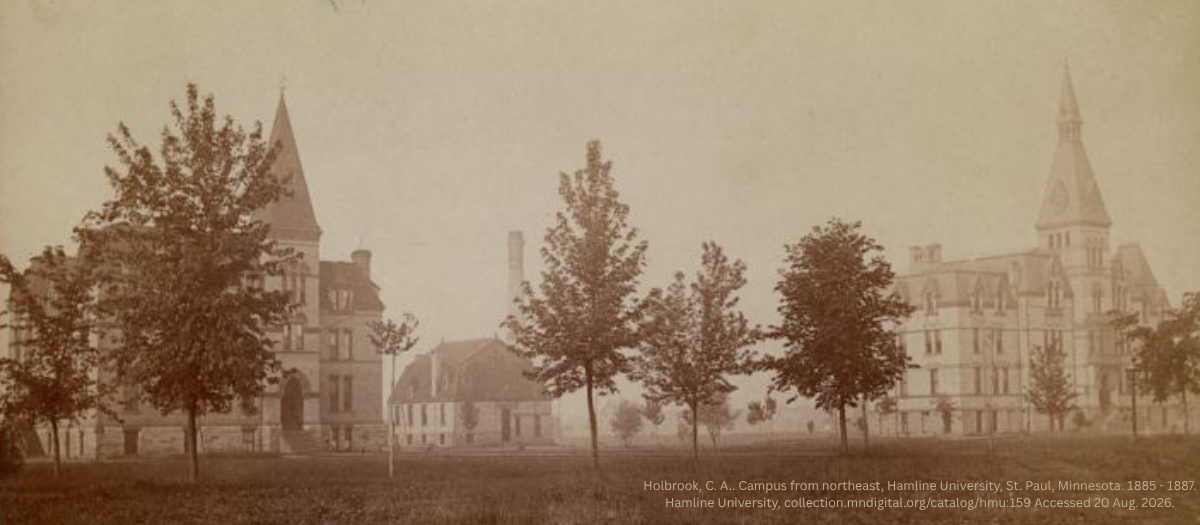
Hamline's archive has existed for roughly 30 years. But when Shandi arrived, she found that many people on campus did not know it was there. She still hears that from longtime faculty and staff.
“A lot of people that have been on this campus for 10, 20 years are like, Shandi, before you got here, I did not know we had an archive.”
Shandi has worked deliberately to change that. She introduces students to archival research in first-year seminars and writing courses. She asks about the organizations they belong to and points out the materials they are already creating that may be worth preserving. A poster for an event. Photographs from a club. Records from a student organization that might otherwise disappear when leadership changes.
For Shandi, this is part of collection development. People are more likely to preserve something when they understand that the archive wants it, and when they know who to contact. Over time, that awareness has started to travel without her. Early in her third year at Hamline, Shandi heard that campus tour guides were telling new students about the archive and talking about ways they could contribute to it.
That kind of recognition matters to her because access has always been central to how she thinks about archival work.
“Accessibility and outreach is why I wanted to be a librarian. And so I just bring that to archiving.”
The archive can preserve Hamline's history, but preservation alone is not the end goal.
Making Time To Be Seen
At Hamline, Shandi's role spans the full range of archival work, from processing and description to reference, instruction, collection development, and outreach. That makes decisions about where to spend her time especially important.
Processing collections is essential, but so is building relationships with the people who create, use, and contribute to them. The challenge is making meaningful progress on both. With Historiq increasing her processing efficiency more than twelvefold, the question is no longer just how Shandi can keep up with the backlog, but what that newfound capacity makes possible.
When the conversation turned to that question, her answer was simple:
“More time for outreach.”
For Shandi, efficiency is not about spending every available hour processing more material. It is about making the time she does spend processing go further, so there is still room to teach a class, attend a campus event, help a researcher, or talk with a department about records that might otherwise be discarded. And those conversations have consequences for the collection. Making processing more efficient does not just help Shandi work through the backlog. It gives her more opportunity to grow it.
Keeping The Backlog Moving
Shandi expects there will always be material waiting to be processed. But she does not see that as permission for collections to sit indefinitely. Her philosophy is that the backlog should keep moving.
“It should also always be circulating. Materials shouldn't be sitting for a long time.”
That creates a cycle. New material comes in as more people learn about the archive. Existing material moves toward description, discovery, and use. As collections become more accessible, there is more for students, faculty, staff, and researchers to find.
Keeping that cycle going means finding ways to reduce the repetitive work involved in processing without reducing the quality of the description. One example comes from records transferred by Hamline's institutional advancement office.
The files contain information about alumni and donors, including news clippings, biographical information, and other material that can document people who may not appear elsewhere in the university's historical record. For years, those materials were largely described at the box level. Going further meant entering hundreds of individual names, one by one. Shandi wanted to make those records more discoverable, but doing so manually would have competed with everything else on her plate.
Making Processing Time Count
Shandi evaluated a number of collections management systems before choosing Una by Historiq. Her bar wasn't feature count, it was whether a tool would actually give her back time to do the outreach work that keeps Hamline's archive growing.
“I did so much research on content management systems. I've worked with many of them already. This is the only one that has ever saved me time, and still been an effective product.”
For Shandi, the value of that time is practical.
“I needed that time saved because it is only me... this is the only way I could ever make this collection actually accessible in my lifetime here. And still do everything else I do.”
Using Una by Historiq, she began describing the institutional advancement records at the folder level. At the time of the conversation, she had cataloged roughly 200 individual files in a single box and was still working through it.
“This system is the only reason that I've actually done a whole box of those.”
Part of the difference is voice-enabled cataloging. Instead of manually typing every name into a separate document, Shandi can speak the file information as she works.
“Otherwise it would be me typing in a Google document all of these names, but instead, I get to say, file 1, John Doe, or Doe, comma, John, and move so much faster without having to click and type.”
The benefit is not just speed. It means records that once existed only as folders inside a broadly described box can become individually searchable.
“It's the only reason I'll be able to search and use those materials for research now.”
For Shandi, faster processing was never the ultimate goal. It's what the saved hours allow her to do: more time out of the stacks and in front of the people who fill them.
- Increase processing efficiency more than twelvefold.
- Describe institutional advancement records at the folder level.
- Catalog roughly 200 individual files in a single box.
- Use voice-enabled cataloging instead of typing names one by one.
- Keep the backlog circulating instead of sitting indefinitely.
- Reclaim time for outreach, instruction, and collection development.
A Richer Historical Record
The result is a richer and more accessible record of Hamline University's history. By making it possible to preserve and describe more of the materials created across campus, Hamline can better capture the people, organizations, events, and everyday experiences that shape its community over time. More of that history is preserved, more of it can be discovered, and more of it remains available to the community it belongs to.